Flintshire once again among lowest funded councils as Welsh Government provisional settlement figures announced

Flintshire has been placed in the joint-lowest band of funding increases in the Welsh Government’s provisional 2026–27 local government settlement.
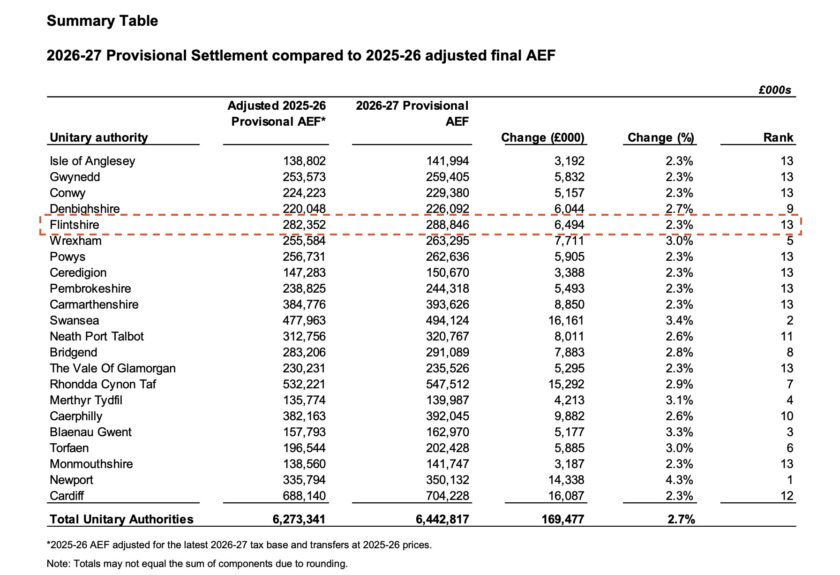
The figures, published today, show Flintshire receiving a 2.3 per cent rise in Aggregate External Finance, placing it in the same bottom-tier group as 11 other authorities. The increase forms part of a wider £6.4bn package for councils across Wales.
The table shows that 2.3 per cent is the minimum uplift applied this year, with all councils in this band listed as rank 13. The ranking reflects an identical percentage increase across the group rather than a single authority in isolation.
The data also shows that Flintshire’s increase is lower than neighbouring Wrexham, which receives a 3.0 per cent rise, and Denbighshire, which receives 2.7 per cent. Swansea records the highest percentage uplift at 3.4 per cent, while Newport receives the highest cash increase at £14.3m.
Flintshire’s cash uplift of £6.494m is mid-range compared with other authorities, but the percentage measure places it at the base of the national table because several councils of differing sizes receive the same minimum increase.
The Welsh Government has noted that the 2.3 per cent floor was applied to ensure no authority received less than that level.
Flintshire People’s Voice finance spokesman, Cllr Alasdair Ibbotson, said:
“Flintshire came fourth from bottom in Welsh Government funding last year, and third from bottom the year before. The Labour-Independent coalition said this was unfair and they’d change it. This year, Flintshire comes last. They’ve failed to meet even the low standard they set for themselves – and yet again, the residents of Flintshire have to pick up the tab for their incompetence.”
Announcing the provisional settlement, Cabinet Secretary for Housing and Local Government Jayne Bryant MS said it remained early in the budget process.
Bryant said, “It is our firm ambition to secure a Final Budget which uses all the resources available for 2026-27, safeguards jobs and protects frontline public services. The First Minister and the Cabinet Secretary for Finance and Welsh Language have been clear it is our collective responsibility to pass the Welsh Budget. We are committed to working with all parties to do just that.
“The provisional settlement provides £6.4bn from the Welsh Government Revenue Support Grant (RSG) and Non-Domestic Rates (NDR) to spend on delivering key services. This is an average increase of 2.7% on a like-for-like basis and includes an additional £5.5m (on top of the £8.6m allocated at draft budget) to ensure no authority receives an increase of less than 2.3%.
“We are all aware of the pressures on households. In 2013-14, we made a choice as a Country to protect vulnerable and low-income households across Wales by maintaining full entitlements to support with their council tax bills, under our national Council Tax Reduction Scheme (CTRS), a choice that has been made every year for more than a decade. The tailored nature of our national scheme means this support is targeted towards those who need it most.
“In 2024-25, this meant that almost 256,500 vulnerable and low-income households – around one in five households – benefited from a reduction in their council tax.
“In line with this joint focus with local government on supporting households, we will continue to maintain the baseline funding of £244m for CTRS in the Settlement.
“In addition to the core settlement, I am publishing indicative information on specific revenue and capital grants planned for 2026-27. At this provisional stage these grants amount to over £1.3bn for revenue and over £1.08bn for capital.
“We continue to work closely with local government throughout the year reflecting the Strategic Partnership Agreement between the Welsh Government and Local Government in Wales that was signed earlier this year.
“It is not appropriate for the Welsh Government to set an arbitrary level of council tax increase. The setting of budgets, and in turn council tax, is the responsibility of each local authority and authorities will need to take account of the full range of sources of funding available to them, as well as the pressures they face. I encourage councils to continue to carefully balance the impact of increases on household finances with the loss of support and services. I know that across Wales, leaders, elected members and officers alike will be striving to find ways to make the best use of their resources to make the most difference for their communities.
“I would like to pay tribute to the incredible amount of hard work and resilience shown across the sector by both officers and elected members over many years to respond to the challenges Councils have been facing. We continue to prioritise our support for local government, as we have throughout our Government through the annual settlement and specific grants to respond to national and local priorities.”
Local implications for council budgets and council tax levels are not yet known.
Check live fuel prices near you before you set off.
Spotted something? Got a story? Email news (@) deeside.com

NEW: Add Deeside.com as a preferred source on Google to see more of our trusted coverage when you search.
Latest News