Flintshire alcohol-specific death rate among lowest in Wales, ONS data shows
Flintshire has the fourth-lowest alcohol-specific death rate of any local authority in Wales, according to new figures from the Office for National Statistics published today.
The county recorded a rate of 11.0 deaths per 100,000 people over the three years to 2024, well below the Welsh average of 16.6 over the same period.
In total, 54 Flintshire residents died from alcohol-specific causes between 2022 and 2024.
Among Welsh local authorities, only the Isle of Anglesey (10.0 deaths per 100,000), Powys (10.5) and Monmouthshire (10.8) recorded lower rates.
Across the rest of the Betsi Cadwaladr University Health Board (BCUHB) area, Gwynedd recorded a rate of 13.3, Wrexham 14.5, Denbighshire 15.4 and Conwy 15.6.
Flintshire’s rate has fallen across the past four three-year periods.
It stood at 12.3 deaths per 100,000 in the three years to 2021, 12.0 in the years to 2022, 11.9 in the years to 2023, and 11.0 in the years to 2024.
The Welsh average moved in the opposite direction over the same four periods, rising from 13.7 to 16.6 deaths per 100,000.
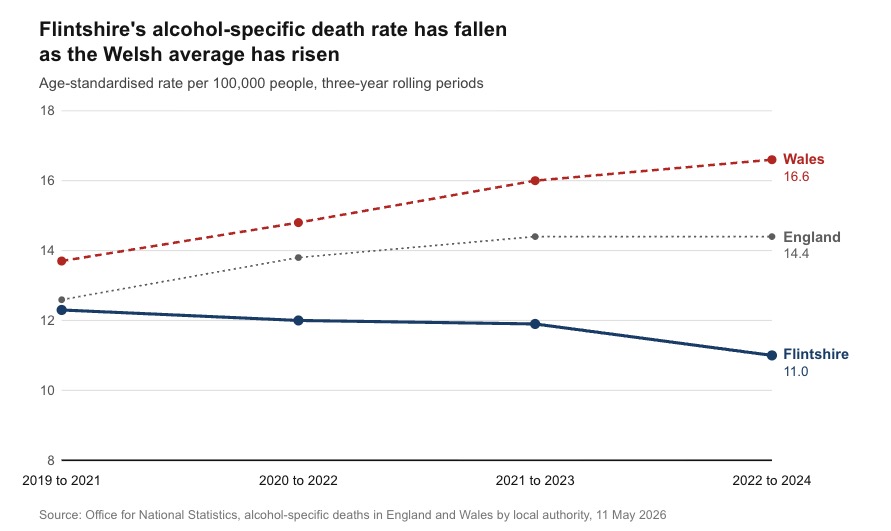
The 2022 to 2024 period is the first time on the rolling figures that the gap between Flintshire and the Welsh average has been wide enough to fall outside the range of statistical uncertainty around each figure.
At the higher end of the Welsh table, Blaenau Gwent recorded a rate of 25.3 deaths per 100,000, Bridgend 23.8, Rhondda Cynon Taf 21.7 and Merthyr Tydfil 21.1.
Across the UK, alcohol-specific deaths fell year-on-year in 2024 for the first time since 2018, ONS said.
The Welsh rate for 2024 alone was 16.8 deaths per 100,000, down on 2023.
Scotland and Northern Ireland continued to have the highest rates of any UK constituent country in 2024, at 20.9 and 21.4 per 100,000 respectively.
Northern Ireland was the only one of the four UK nations to record an increase in 2024 when compared with 2023.
ONS publishes alcohol-specific death rates for local authorities as rolling three-year aggregates rather than single years, to reduce the influence of small annual fluctuations on areas with smaller populations.
The figures cover deaths from conditions where alcohol is the direct cause, such as alcoholic liver disease, alcohol-induced pancreatitis, and accidental or intentional alcohol poisoning.
They do not include deaths where alcohol is a contributing factor but not the wholly attributable cause, such as some cancers and cardiovascular conditions.
If you are concerned about your own drinking or someone else’s, support is available from Alcohol Change UK and from the NHS.
Check live fuel prices near you before you set off.
Spotted something? Got a story? Email news (@) deeside.com

NEW: Add Deeside.com as a preferred source on Google to see more of our trusted coverage when you search.
Latest News