Wales has more NHS staff than before the pandemic and spends more than England, so why is north Wales going backwards?
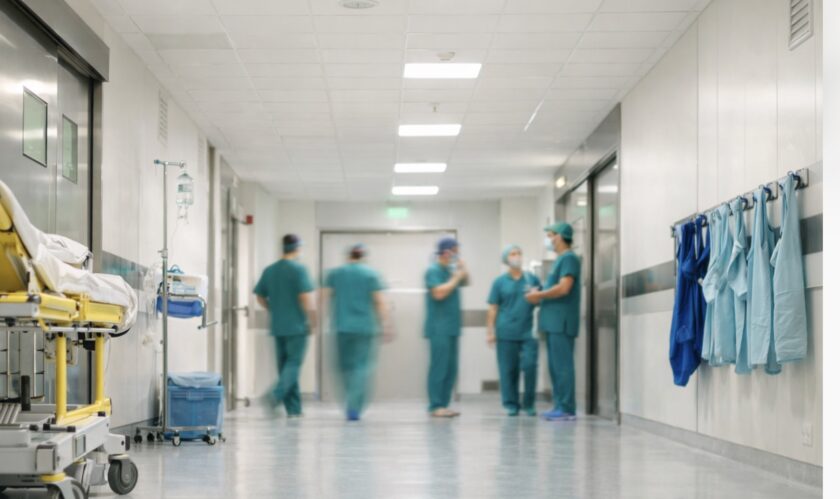
Betsi Cadwaladr University Health Board has been named as the primary cause of Wales’s deteriorating accident and emergency performance in an independent report published today ahead of the Senedd election.
The Institute for Fiscal Studies found that just 42% of patients in the Betsi Cadwaladr area were seen within four hours in major A&E departments in December 2025.
The Wales average for the same month was 52.7%.
England recorded 59.6% and Scotland 62.9%.
The NHS target is 95%.
The IFS, which produced the report as part of a series of Welsh election briefings, said performance elsewhere in Wales had been “roughly flat over the last two years” and that north Wales was driving the national figures down.
Betsi Cadwaladr University Health Board covers around 700,000 people across north Wales, including Flintshire, and has been in special measures since 2023.
More money, more staff, worse results
The deterioration in north Wales is happening despite significant increases in spending and staffing.
Health spending in Wales rose by 17% per person after inflation between 2019-20 and 2024-25, a larger increase than in England over the same period.
The Welsh NHS had 23.6% more staff in April to September 2025 than in the same period in 2019.
Outpatient appointments across Wales are up 25% on pre-pandemic levels.
Yet A&E performance in north Wales has continued to worsen, and the waiting list for planned treatment remains far higher than before the pandemic.
The IFS identifies a likely fall in hospital productivity.
Despite 23.6% more staff, hospital admissions in Wales have only just returned to pre-pandemic levels.
More people are being employed, but fewer patients are being admitted than the staffing increase would suggest.
One factor the IFS points to: the average inpatient stay in Wales is 6.7 days, around 40% longer than in England.
Longer stays mean fewer beds available, which means fewer patients admitted.
Planned treatment
The typical wait for planned treatment in Wales was 19 weeks in December 2025, compared to 10.7 weeks in December 2019 before the pandemic.
In England in December 2025 it was 13.4 weeks.
Almost one in five patients in Wales, 19.3%, were waiting more than a year for planned treatment in December 2025.
Before the pandemic that figure was 1.5%.
The Welsh Government set targets in 2022 to eliminate waits of more than a year in most specialties by spring 2025.
The Senedd’s own Health and Social Care Committee concluded in November 2025 that none of those targets had been met, including for cancer and diagnostic testing.
There has been some improvement.
The typical wait fell from 23.5 weeks at the start of 2025 to 19 weeks by December.
The IFS describes that as welcome but says the current position is “still almost twice as long as pre-pandemic and 40% longer than comparable waiting times in England.”
Schools and young people
The IFS also looked at education across Wales.
The share of 16 and 17-year-olds in full-time education in Wales fell from 78% in 2014 to 64% in 2024.
In England over the same period it went up, from 82% to 84%.
By individual age, only 59% of 17-year-olds in Wales were in full-time education in 2024, down from 73% a decade earlier.
The share of 18-year-olds going on to university has fallen to 29%, below 2016 levels and well below England’s 37%.
The IFS says the reasons are not well understood and need to be investigated.
On school attendance, Welsh pupils missed 9% of sessions in 2024-25, roughly 17 days per pupil across the year.
Before the pandemic the figure was under 6%.
England’s current rate is around 7%.
The share of pupils missing more than 10% of sessions, classed as persistently absent, more than doubled from 15% in 2019 to 34% by 2025.
Welsh 15-year-olds also scored consistently below their English counterparts in PISA tests, an international assessment of reading, maths and science ability, with the gap widening in the most recent results from 2022.
On average, a Welsh pupil in the middle of the income range performs no better in those tests than a pupil from the poorest fifth of families in England.
Spending per pupil in Wales and England is now almost identical, at £8,700 and £8,600 respectively in 2025-26.
What is driving it
The IFS is careful on this point.
The people working in Welsh hospitals and schools are not the cause.
The report points to how services are organised and managed, and is explicit that the full picture is not yet clear.
Two specific factors are identified on the health side.
The average inpatient stay in Wales is 6.7 days, around 40% longer than in England.
When patients stay longer, beds fill up more slowly, fewer people can be admitted, and the system backs up.
That is a structural issue, not a reflection of the care being provided.
On schools, the IFS says accountability for poor performance may be weaker in Wales, with less data available to teachers, parents and policymakers to identify where things are going wrong and put them right.
David Phillips, head of devolved and local government finance at the IFS, said the causes were “not fully clear” and that more work was needed to understand them.
He said funding “seems unlikely to be a major factor given spending in Wales is higher than comparable areas of England” and that deprivation “can likely only explain part of it.”
“Instead, policies and the way services are delivered are likely to play a role,” he said.
In response to the performance and productivity challenges, the Welsh Government commissioned an independent review which reported in April 2025.
The Welsh Government accepted 18 of its recommendations in full and accepted a further 11 in part.
The recommendations focused on reducing variation between health boards, stronger performance management, and better measurement of productivity.
Opposition parties at the Senedd said the findings confirmed longstanding concerns about policy decisions under the Labour-led Welsh Government.
What comes next
Whoever wins the Senedd election in May inherits a difficult financial position.
The 2026-27 Welsh Budget as currently set implies a 2.2% cut to health and social care spending after inflation.
The IFS says that is “simply inconsistent with planned pay increases or maintaining, let alone improving, service quality.”
An extra £322 million confirmed in the UK government’s 2026 Spring Statement gives the next Welsh Government some room immediately after the election.
But the IFS says that money is largely one-off and “simply postpones the pain to later years.”
In 2027-28 and 2028-29, if the next Welsh Government wanted to match England’s planned health increases and protect council budgets, spending on everything else, including transport, further education and economic development, would face cuts averaging 4.9% a year on current funding forecasts.
The Welsh Government has not published spending plans beyond 2026-27.
A Welsh Government spokesperson told the BBC the government had set clear expectations for all health boards to reduce emergency department long stays and complete ambulance handovers within 45 minutes, and that the NHS waiting list had fallen with the longest waits coming down.
The full IFS report is at ifs.org.uk.
Check live fuel prices near you before you set off.
Spotted something? Got a story? Email news (@) deeside.com

NEW: Add Deeside.com as a preferred source on Google to see more of our trusted coverage when you search.
Latest News