NHS waiting lists in Wales still 50% above pre-pandemic levels, Audit Wales warns

The number of people waiting for planned NHS treatment in Wales is still around 50% higher than before the Covid-19 pandemic, according to a new report from Audit Wales.
Around 185,000 planned care pathway waits exceeded 36 weeks in February 2026.
Before the pandemic, the target was for all patients to start treatment within 36 weeks.
In February 2019, around 13,300 pathway waits exceeded that threshold.
The February 2026 figure is approximately 14 times higher.
Audit Wales published the findings on 8 June 2026, covering planned care performance across all seven health boards in Wales.
The report found that between 2022-23 and 2024-25, health boards received an extra £547 million from the Welsh Government to reduce the longest waits.
Much of that funding went on expensive short-term measures, including contracts with private providers and additional weekend surgical sessions, rather than lasting change.
The Welsh Government set a target to eliminate two-year waits by March 2023, then extended it to March 2024.
Both deadlines were missed.
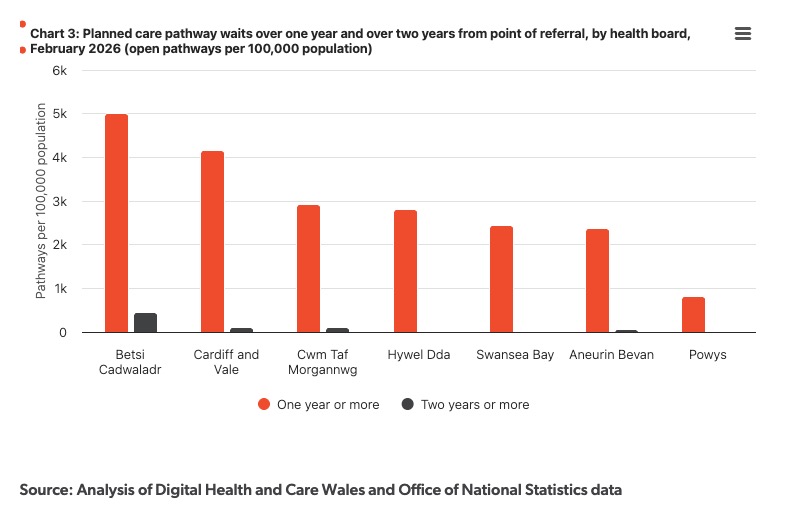
As of February 2026, just over 4,500 people across Wales had been waiting more than two years for planned care, down from a peak of around 70,400 in March 2022.
Orthopaedics, ophthalmology and general surgery together accounted for just over half of approximately 106,000 waits of more than one year across Wales.
Audit Wales found that health boards were not doing enough to forecast longer-term growth in demand, and did not have clear plans to create the capacity needed to meet it.
In 2024-25, around 207,000 face-to-face outpatient appointments were missed by patients, accounting for 7.4% of all appointments.
Audit Wales estimated that cutting missed appointments by one fifth could save around £6.7 million a year.
Health boards also cancelled almost 18,000 operations at short notice in 2024-25, roughly 350 per week.
No health board in Wales was meeting the good practice target of 85% of all surgery being carried out as day-case surgery as of the period March 2025 to February 2026.
Betsi Cadwaladr University Health Board, which covers north Wales including Flintshire and Deeside, was among the health boards where planned care performance “remains poor or is deteriorating,” according to a separate Audit Wales structured assessment published in March 2026.
That report found the Welsh Government was unable to approve BCUHB’s medium-term plan, in part because it lacked sufficient detail on how the health board would meet delivery expectations for planned care, cancer, diagnostics and urgent and emergency care.
In November 2025, the then Cabinet Secretary for Health and Social Care announced that a team of experts would work alongside the BCUHB chief executive and board to drive rapid improvements across a number of key service areas.
BCUHB remains in special measures, the highest level of intervention under the Welsh Government’s escalation framework.
Mabon ap Gwynfor MS holds the health portfolio in the new Plaid Cymru Welsh Government.
Audit Wales said the NHS must now move from short-term fixes to transforming services so they are more efficient, meet future needs, and deliver value for patients.
Check live fuel prices near you before you set off.
Spotted something? Got a story? Email news (@) deeside.com

NEW: Add Deeside.com as a preferred source on Google to see more of our trusted coverage when you search.
Latest News