Future-Proofing Deeside’s Manufacturing: The Shift Towards Energy-Efficient Facilities
The Hidden Energy Drain in Manufacturing Facilities
Modern factories are highly automated, relying on complex electronic systems that operate around the clock. This automation brings incredible efficiency, but it also introduces a highly overlooked energy drain: Thermal Management.
When industrial machinery runs continuously, the internal components generate severe heat. If this heat is not effectively dissipated, equipment degrades faster, and energy consumption skyrockets as legacy cooling systems overwork to compensate.
In modern manufacturing environments, control cabinets and automated electronic enclosures generate substantial heat. Relying on outdated HVAC or legacy cooling mechanisms often leads to thermal bottlenecks and excessive power consumption.
Today, facility engineers are increasingly replacing these with advanced industrial cooling fans from ACDCFAN, such as EC models. These dynamically adjust their speed and consume significantly less energy than traditional AC counterparts while maintaining rigorous IP-rated protection against factory dust and moisture.
Ignoring thermal bottlenecks can lead to:
- Unexpected machine downtime due to overheated circuit boards.
- Exponentially higher electricity bills from inefficient AC motor fans.
- Shorter lifespans for expensive control cabinet components.
Why North Wales and Deeside are Embracing Smart Industry
The Deeside Industrial Park is a cornerstone of the North Wales economy, housing advanced aerospace, automotive, and packaging manufacturers. As global supply chain pressures mount, these local facilities are rethinking their operational frameworks.
To remain globally competitive, Deeside manufacturers are actively transitioning toward “Smart Industry” or Industry 4.0 standards. This shift is driven by the need for greater output with a shrinking environmental footprint.
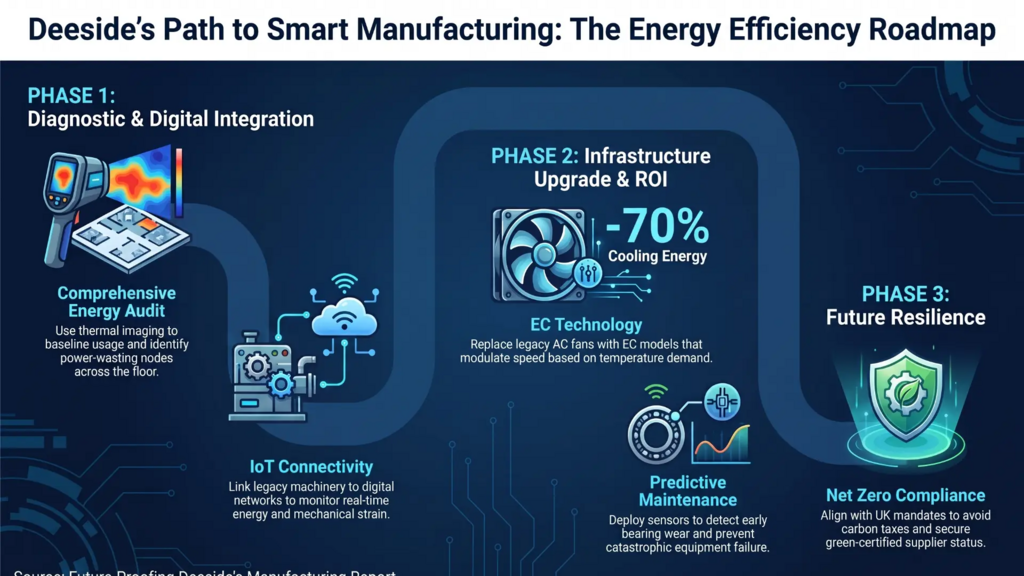
A major catalyst for this transition is the integration of the Internet of Things (IoT). By connecting legacy machines to digital networks, plant managers can monitor real-time energy usage and pinpoint exact areas of mechanical strain.
Furthermore, strict regional and national carbon emission standards are forcing the hand of heavy industry. Welsh manufacturers are no longer just looking at output; they are scrutinized on their carbon intensity per unit produced.
Key Steps to Upgrading Facility Infrastructure
Conducting Comprehensive Energy Audits
Before investing in new hardware, facility engineers must baseline their current energy usage. A comprehensive energy audit identifies the specific nodes within a factory where power is being wasted.
Auditors typically deploy thermal imaging and power logging tools across the factory floor. They look for:
- Continuous-running exhaust systems that operate even when machines are idle.
- Poorly sealed electronic enclosures that leak cooled air.
- Aging motors that draw excessive amperage during startup phases.
Once these baseline metrics are established, plant managers can build a data-driven business case for infrastructure upgrades, ensuring capital is deployed where it yields the highest return.
Implementing EC Technology and Predictive Maintenance
The shift from alternating current (AC) to Electronically Commutated (EC) technology is revolutionizing factory floor thermal dynamics. EC motors combine the best of AC and DC technologies, utilizing a built-in electronic controller to optimize fan speed based on real-time temperature demands.
Unlike traditional fans that run at a fixed, wasteful speed, EC systems modulate their output. This single upgrade can reduce cooling energy consumption by up to 70% in large-scale server racks and control cabinets.
Coupled with predictive maintenance, this technology transforms facility management. Sensors detect early signs of bearing wear or unusual temperature spikes, alerting technicians before a catastrophic failure occurs.
Predictive maintenance benefits include:
- Elimination of costly, unplanned operational halts.
- Optimized labor allocation for maintenance crews.
- Extended lifecycle of critical manufacturing assets.
The Economic and Environmental Impact of Energy Compliance
Upgrading infrastructure requires upfront capital, but the long-term Return on Investment (ROI) is undeniable. Lower electricity bills immediately improve profit margins, making Welsh facilities more competitive in international markets.
Beyond individual profits, this industrial evolution aligns directly with the UK’s broader Net Zero mandates. Reducing industrial energy waste is a non-negotiable step toward meeting these ambitious climate milestones.
The push for upgraded facility infrastructure is not just about immediate cost savings for Deeside businesses; it is a critical component of national sustainability targets.
Data shows that the industrial sector accounts for a significant portion of the country’s energy consumption, prompting strict guidelines for energy efficiency and carbon reduction aimed at future-proofing local economies.
By achieving compliance ahead of regulatory deadlines, forward-thinking manufacturers avoid future carbon taxes and position themselves as premium, green-certified suppliers to eco-conscious buyers.
Key Takeaways
| Area | Key Takeaway | Impacts/data |
| Thermal management | Eliminate traditional overheated AC fans | Eliminate downtime and soaring electricity bills |
| Technology | Using EC electronic speed control motor | Reduce cooling energy consumption by up to 70% |
| Operation and maintenance | Deploying IoT and Predictive Maintenance | Extend asset life and downtime |
| Compliance | Early achievement of carbon reduction standards | Avoid carbon taxes and lock in green orders |
Conclusion: A Resilient Industrial Future for Wales
The manufacturing landscape in North Wales is at a critical juncture. The days of treating energy as a fixed, unmanageable overhead cost are entirely over.
For Deeside’s industrial sector to thrive in the coming decades, embracing intelligent thermal control and IoT integration is mandatory. Adapting to these new technological and environmental standards is the only way to secure long-term resilience.
Check live fuel prices near you before you set off.
Spotted something? Got a story? Email news (@) deeside.com

NEW: Add Deeside.com as a preferred source on Google to see more of our trusted coverage when you search.
Latest News