About Mold
Where it is and what it does today
Mold sits in the foothills of the Clwydian Range, eight miles west of Chester and roughly twelve miles north of Wrexham.
It is the county town of Flintshire, which means it is where Flintshire County Council is based and where the administrative machinery of the county operates.
That makes it smaller than you might expect from a county town — around 10,000 people live in the town itself — but busier than its size suggests, because people come in from across the county for shopping, the market, the theatre, and the council offices.
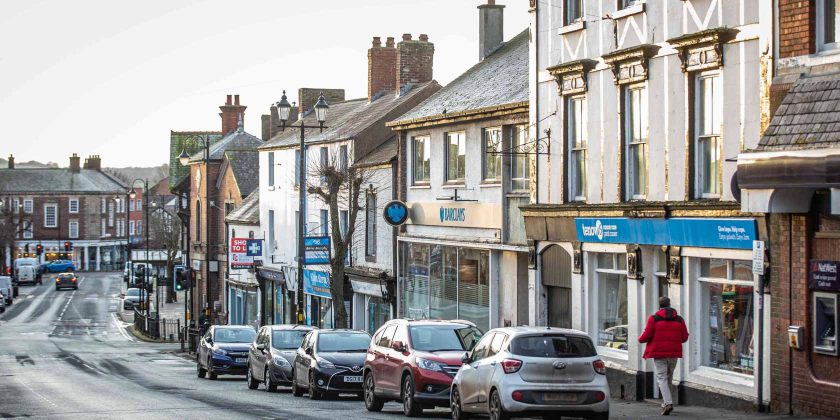
The town centre sits on a gentle hill above the River Alyn.
High Street runs down from the parish church of St Mary’s to Daniel Owen Square, and on Wednesday and Saturday the whole stretch fills with market stalls.
Mold is about thirty minutes from the A55 corridor at Ewloe, which connects it to Deeside, Chester, and beyond.
The name and the Welsh name
The Welsh name for Mold is Yr Wyddgrug.
It translates as “the burial mound,” a reference to the same landscape feature that gave the town its English name.
That English name almost certainly comes from the Norman French *mont haut*, meaning high hill, which became Montalt, then Mold over time.
The Norman family who built the castle here took their name from the place: de Montalt.
So the town’s name and the family’s name came from the same mound, and the mound predates both of them by thousands of years.
The Norman castle
A motte-and-bailey castle was built on Bailey Hill, the prominent mound at the centre of town, around 1072.
It was erected by Robert de Montalt, probably under instructions from Hugh d’Avranches, the Norman Earl of Chester, as part of the broader push to assert control over north-east Wales after the Conquest.
A motte-and-bailey was the standard Norman fast-build: a raised earth mound with a wooden keep on top, a courtyard at the base enclosed by a timber palisade and ditch.
Bailey Hill changed hands repeatedly over the following two centuries, moving between Norman lords and Welsh princes as power shifted across the border.
Owain Gwynedd captured it in 1146.
Llywelyn ap Iorwerth held it in the early thirteenth century.
The site lost its military function by the late medieval period, and the timber structures rotted away.
By 1790 the Mostyn family, who then owned it, had walled it off and planted it as a garden.
It has been public open space since 1890, when Mold Council bought it.
The earthworks are a scheduled ancient monument.
The mound itself is still there, rising above the surrounding streets, with views across the town.
The Mold Cape
In 1833, a group of workmen quarrying stone from a burial mound on the edge of town broke into a Bronze Age grave.
Inside they found fragments of crushed gold wrapped around a human skeleton, along with amber beads and strips of bronze.
The burial mound was known locally as Bryn yr Ellyllon — in English, Goblins’ Hill.
The gold fragments turned out to be a cape, hammered from a single gold ingot and decorated with rows of embossed ridges that imitate the look of strings of beads.
It dates to between 1900 and 1600 BC.
The vicar of Mold, Charles Butler Gough, recorded what had been found.
The finds were shared out among the workmen and the landowner.
The landowner sold the largest pieces to the British Museum in 1836, and over the following decades most of the surviving fragments were recovered and painstakingly reassembled.
The Mold Cape is now one of the British Museum’s most important prehistoric objects.
There is no agreement on who wore it or what it was for.
Its scale and quality — produced from a single ingot, beaten to a thickness of less than half a millimetre across its full width — suggest a society with highly specialised craftspeople and the resources to commission extraordinary objects.
A replica is held at Mold library and museum.
The original discovery site, Bryn yr Ellyllon, was beside what is now the A541 Chester Road on the edge of town.
Nothing of the mound remains.
Daniel Owen
Daniel Owen was born in Mold on 20 October 1836 and died there on 22 October 1895.
He is generally regarded as the first significant novelist to write in Welsh and the foremost Welsh-language novelist of the nineteenth century.
His father and two of his brothers were killed when he was a baby, when the Argoed colliery flooded in May 1837.
His family stayed in Mold in poverty.
At twelve he was apprenticed to a tailor, Angel Jones, a prominent member of the Calvinistic Methodist chapel in town.
Owen described the tailor’s workshop as a kind of college — it was where he learned to read people, to listen, and to argue.
He trained briefly for the ministry at Bala College in 1865 but returned to Mold before completing his course.
He spent the rest of his life working as a tailor and writing.
His major novels – Rhys Lewis (1885), Enoc Huws (1891), and Gwen Tomos (1894) – were serialised chapter by chapter in Welsh-language periodicals.
They are set in a fictionalised version of Mold and its Calvinistic Methodist chapel world.
The characters are drawn from the people he observed in the tailor’s shop, the chapel, and the streets of the town.
Owen’s influence on Welsh-language fiction runs directly through to Kate Roberts and T. Rowland Hughes.
His statue, commissioned after his death and sculpted by Goscombe John, stands at the entrance to Mold library.
The shopping precinct beside the library is named after him.
The Daniel Owen Memorial Prize at the National Eisteddfod, awarded for an unpublished novel in Welsh, carries his name.
The Mold riot of 1869
On 2 June 1869, soldiers opened fire on a crowd outside the courthouse in Mold and killed four people.
The events had begun at a colliery trial.
Eight miners were convicted of assaulting their manager.
As the prisoners were taken out of the courthouse, a crowd had gathered — miners, their families, and bystanders from the town.
The soldiers, brought from Chester, fired into the crowd.
Four people died: Margaret Younghusband, a nineteen-year-old domestic servant who had stepped out of a church to see what was happening and was shot in the leg; Edward Bellis, a twenty-one-year-old collier; Elizabeth Jones, fifty, the wife of one of the convicted miners, shot in the back as she stood nearby; and Robert Hannaby, a teenage collier, shot in the head.
The Riot Act had not been read before the soldiers fired.
A coroner’s jury returned a verdict of justifiable homicide.
Five men were subsequently convicted of riot and sentenced to ten years’ penal labour, including Isaac Jones, whose wife Elizabeth had been killed.
The event is remembered in Mold by two blue plaques: one at the corner of Tyddyn Street and one on the wall of the Old Court House.
It was one of the most serious incidents of state violence against a civilian crowd in nineteenth-century Wales.
The nineteenth century and beyond
The railway arrived in Mold in the 1840s, connecting it to the wider network and opening up the lead mining and agricultural hinterland further to commerce.
Wesleyan and Calvinistic Methodist chapels shaped the town’s social life through the nineteenth century, and the Welsh language remained strong.
The town’s role as an administrative centre was confirmed at local government reorganisation in 1974, when the county of Clwyd was created and Mold became its county town.
When Clwyd was abolished in the further reorganisation of 1996, Flintshire was reconstituted as a unitary authority and Mold remained its administrative centre.
Theatr Clwyd opened on a site above the town in 1976 and has been the county’s main arts venue since.
The county council’s headquarters moved from County Hall to Tŷ Dewi Sant in Ewloe in recent years, but Mold retains its function as the commercial and civic heart of Flintshire.
Mold also sits within the Clwyd constituency for UK Parliament, represented by Becky Gittins MP.
For the Senedd it is part of the Fflint Wrecsam constituency, created in 2026 when the number of Senedd constituencies was reduced from 40 to 16.
Check live fuel prices near you before you set off.
Spotted something? Got a story? Email news (@) deeside.com

NEW: Add Deeside.com as a preferred source on Google to see more of our trusted coverage when you search.
Latest News