About Connah’s Quay
The largest town in Flintshire grew from a stretch of riverside fields into a shipbuilding and railway port, and reinvented itself again around power and industry.
Connah’s Quay sits on the south bank of the River Dee in north Flintshire, between Shotton and Flint and a short distance west of Chester. It is the largest town in Flintshire and part of the wider Deeside conurbation, running almost without a break into its neighbours. Locally, it is known simply as “The Quay”.
The town that exists today is barely two centuries old. For most of its history, the land here was fields, marsh and a scatter of farms, recorded in the Domesday Book of 1086 under the name Wepre. The change came from the river. As the Dee silted up and Chester’s days as a working port came to an end, trade moved downstream to the Flintshire bank, and a town grew up around a new quay.
Where the name comes from
The town was first known as New Quay. It became Connah’s Quay at some point after the 1860s, and the origin of the name is genuinely uncertain.
The most repeated explanation is that it was named after James Connah, who lived from 1732 to 1787 at the building still standing as the Old Quay House on Dock Road, and who belonged to a local family connected with industry on the river. There is no firm documentary proof, and other accounts have circulated for as long as the name itself. One holds that Connah ran a chandlery, a shop selling rope, canvas and ship’s supplies, on the docks. Another says a Mary Connah owned the quay, and that travellers crossing the Dee from the Wirral would ask to be taken across to “Connah’s Quay”. The truth has never been settled.
What is documented is the engineering that made the port possible. The New Cut, a straightened channel dug to keep the Dee navigable, was completed in 1737. A coal-carrying tramway reached the quay by 1799. The river that had once stranded Chester now carried ships to the Flintshire shore instead.
The working quay
Through the 19th century Connah’s Quay became a port and an industrial town. Coal mined inland around Buckley was brought down to the docks for shipment, and the population climbed as work arrived.
The railways followed the coal. The Buckley Railway opened a through route from the Buckley pits and brickworks down to the Dee in 1862, linking the quay to the main line. The Wrexham, Mold and Connah’s Quay Railway was incorporated the same year and built out across the area, and Connah’s Quay station opened on the Chester to Holyhead line on 1 September 1870. For more than thirty years the town was a working railway junction as well as a port.
Shipbuilding became part of the town’s identity. The Ferguson yard on the Dee built wooden sailing coasters, the best known being the topsail schooner Kathleen & May, launched at Connah’s Quay in 1900 and now preserved as a historic ship. Just downstream, the steelworks founded by John Summers and Sons in 1896 grew into one of the area’s largest employers and survives today, on the north bank, as the Tata Steel plant at Shotton.
Decline and reinvention
The port did not last. By the late 1950s the docks had largely silted up and trade had stopped, and the railway through the town was in decline. Connah’s Quay station closed on 14 February 1966. The old quay that gave the town its name fell quiet.
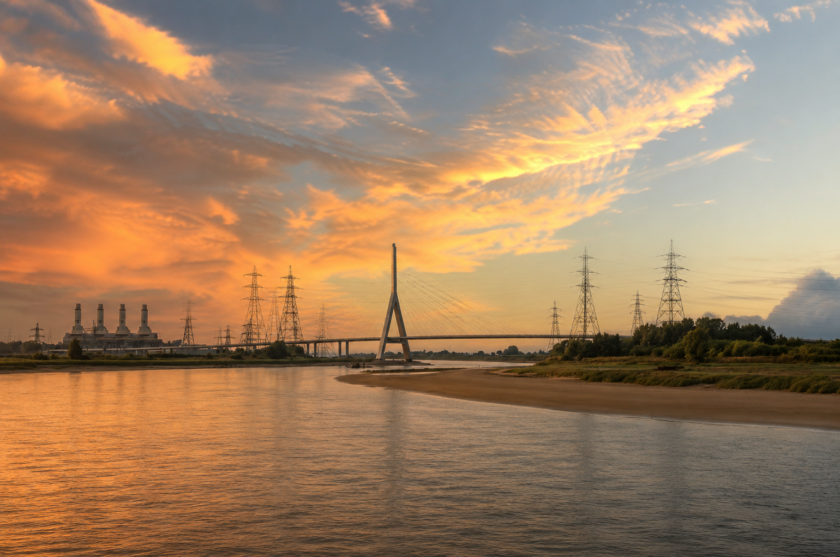
What replaced it was housing and power. Estates spread across the town through the second half of the 20th century, and energy generation took hold on the riverside. A coal-fired power station built in the 1950s closed in 1984 and was demolished in 1992. Its replacement, a gas-fired station completed in 1996, still stands on the south bank and remains one of the largest of its kind in Britain.
The Flintshire Bridge, the tall cable-stayed crossing that dominates the skyline north of the town, opened on 6 March 1998. It was built to carry the A548 across the Dee towards Deeside Industrial Park, one of the largest industrial estates in Europe, which had by then become the economic centre of gravity for the whole area.
Connah’s Quay is now largely a commuter and residential town. Many residents work across the river on Deeside Industrial Park or at the major employers nearby, and Chester is within easy reach to the east.
Its riverside identity has held. The quayside and the Wales Coast Path run along the Dee, Wepre Park covers 160 acres of woodland on the southern edge of the town, and the town’s name carries through its best-known sporting export, Cymru Premier football club Connah’s Quay Nomads. The port has gone, but the place it created has not.
You can read more across our page, including Wepre Park and Connah’s Quay Nomads.
Check live fuel prices near you before you set off.
Spotted something? Got a story? Email news (@) deeside.com

NEW: Add Deeside.com as a preferred source on Google to see more of our trusted coverage when you search.
Latest News