Most Welsh voters do not understand new Senedd voting system, study finds
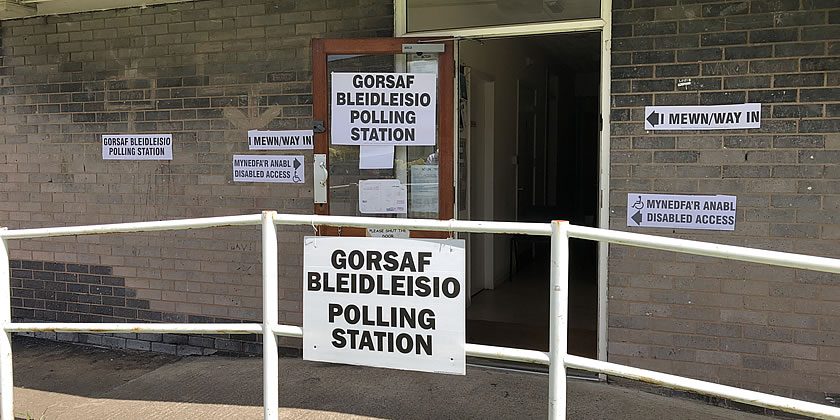
Most voters in Wales do not understand how the new Senedd voting system works, less than two weeks before the election on 7 May.
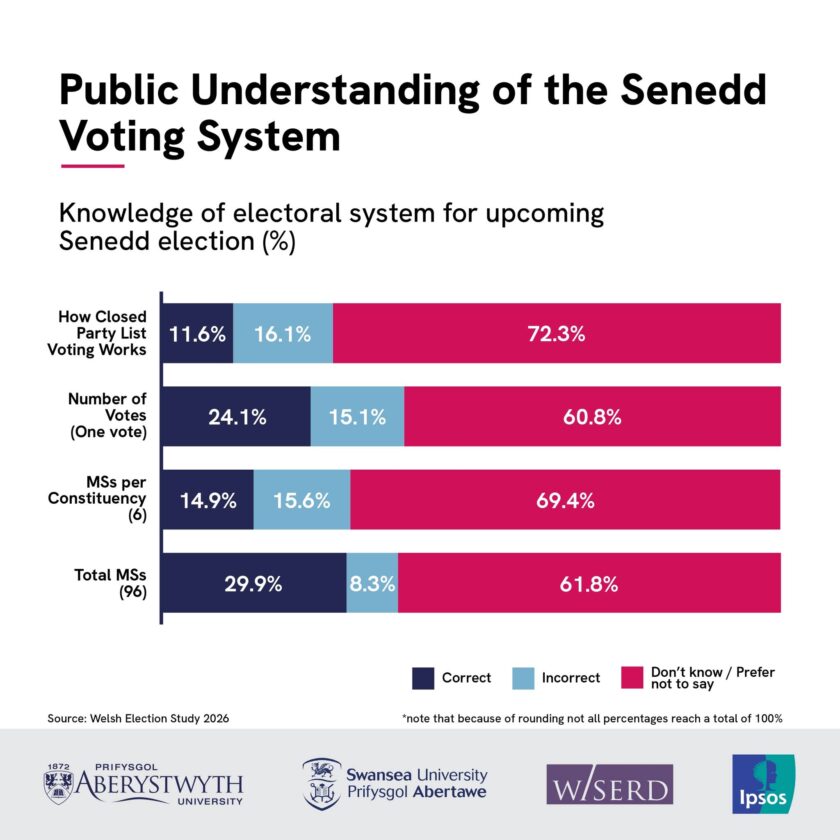
Two-thirds of people surveyed for the Welsh Election Study 2026 were unable to correctly answer questions about the expansion of the Senedd, the creation of new constituencies, and how the electoral system will work.
88% were either incorrect or did not know about the new closed list system.
Just under 12% understood it.
The findings are based on a representative sample of 10,001 adults aged 16 and over, surveyed by Ipsos UK between 26 February and 7 April this year.
Flintshire is part of the new Fflint Wrecsam constituency, one of 16 created under the reforms.
Each constituency will return six Members of the Senedd, with seats allocated proportionally based on the share of the vote each party receives.
Under the new system, each voter casts one vote for a party rather than for an individual candidate.
Survey respondents were also asked about devolution.
Around half were incorrect or unaware that the Senedd controls the NHS, agriculture and economic development.
Only 40% knew that the UK Government retains powers over policing.
The study found a generational gap in understanding.
Only 28% of respondents aged 16 to 25 knew that the Welsh Government is responsible for the NHS, compared with 62.7% of those aged 65 and over.
Trust in government was low.
Over two-thirds of respondents reported limited or no trust in the UK Government.
Almost half reported mistrust of the Welsh Government.
When asked about their ability to influence decisions, more than 60% said they felt they had no influence over UK Government decisions.
The figure was 52% for decisions affecting Wales, and just over 40% at local level.
Asked to describe the upcoming Senedd election in one word, 83% of respondents used negative terms.
The most common were disappointment, frustration and worry.
17% used positive terms.
Dr Anwen Elias, of Aberystwyth University, who led the analysis, said:
“These findings provide an important insight into how people in Wales understand and engage with politics at a crucial moment ahead of the Senedd election. They highlight gaps in awareness of major electoral reforms and raise important questions about democratic participation, trust in government, and how well-informed people feel when making political decisions.”
Dr Elias added that knowledge of the electoral reforms was “generally very low”, with slightly more awareness of the number of Senedd members being elected than of how the closed list system itself will work.
Dr Bettina Petersohn, of Swansea University, said:
“The findings tell us something interesting about the people in Wales and their attitudes towards Welsh politics. The responses show that people have generally positive attitudes towards key democratic processes in Wales, are interested in the upcoming election, with a majority thinking that it makes a difference who will win the Senedd election. At the same time, the level of knowledge about the new electoral system was low at the start of the electoral campaign. Overall, people also expressed the feeling of not having much influence over decisions made for the UK, but also for Wales or the local area.”
The Welsh Election Study 2026 is a four-year project funded by the UKRI Economic and Social Research Council.
It is run by researchers at Aberystwyth University and Swansea University, in partnership with the Wales Institute of Social and Economic Research and Data.
The Senedd election takes place on Thursday 7 May.
Check live fuel prices near you before you set off.
Spotted something? Got a story? Email news (@) deeside.com

NEW: Add Deeside.com as a preferred source on Google to see more of our trusted coverage when you search.
Latest News