Annual archaeological excavation under way at Grosvenor Park in Chester
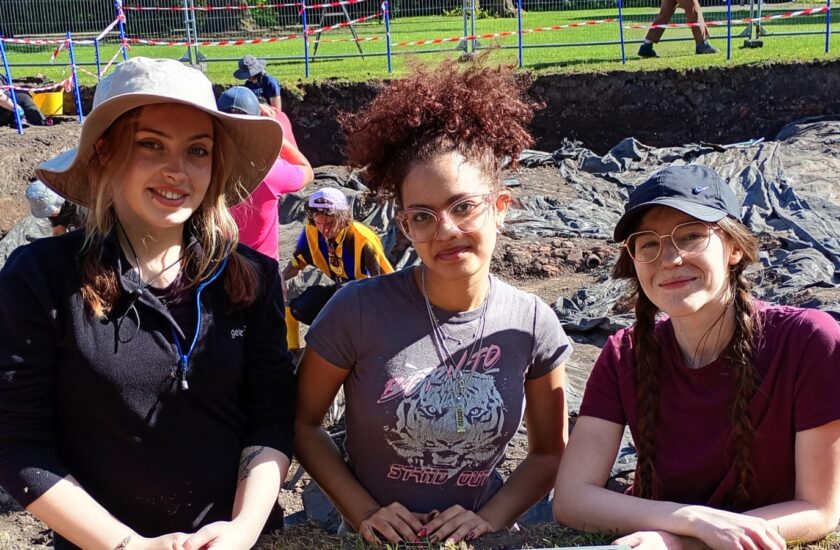
The annual archaeological excavation at Chester’s Grosvenor Park is under way, with 28 University of Chester students digging for evidence of Roman-era buildings.
The four-week dig started on Monday and runs until Friday 22 May.
It is a joint project between Cheshire West and Chester Council, West Cheshire Museums, and the University of Chester’s School of Humanities and Social Sciences.
Last year’s excavation produced Roman ditches and pits containing a large quantity of pottery, including amphorae from the Mediterranean and ceramics made in Roman Eastern Gaul, in what is now Germany.
An unusual find was a piece of Roman ceramic candlestick.
Previous excavations have also uncovered a Roman road running towards Chester’s amphitheatre.
One of the main aims this year is to find buildings that would show people were living in the park during the Roman period, nearly 2,000 years ago.
The dig will also investigate medieval remains found in earlier seasons.
In 2025, a large square stone hearth or oven base was discovered inside a medieval building, lying beneath the remains of a later structure dating to the late medieval or 16th century period.
That later building is believed to have been acquired by Sir Hugh Cholmondeley in the late 1500s and converted into his Chester house.
It was destroyed during the English Civil War, when Parliamentarian soldiers besieging the Royalist city were stationed in the area around the Church of St John the Baptist.
Students will also try to determine whether a section of medieval ditch found running east to west in 2024 connects with another running north to south, discovered in 2021.
A large Saxon ditch already known to run through the middle of the trench may have been the defensive boundary of an early medieval settlement on the site of the amphitheatre.
The project began in 2007 with the aim of understanding how the amphitheatre and the Church of St John the Baptist, founded in the Saxon period and rebuilt as a Norman cathedral, shaped the surrounding area over the centuries.
Councillor Lisa Denson, Cabinet Member for A Fairer Future at Cheshire West and Chester Council, said:
“The excavations have revealed a Roman road, part of a large Saxon defensive ditch, as well as the remains of a medieval building. The site has also revealed the largest amount of English Civil War equipment to be found in Chester.”
Dr Hannah Ewence, Head of Humanities, Cultures and Environment at the University of Chester, said:
“This partnership provides a valuable opportunity for students to bring their learning to life by putting their skills into action, gaining practical experience, and contributing to enhancing our understanding of Chester’s rich heritage.”
A free open afternoon will be held on Tuesday 19 May from 2pm to 4.30pm, with site tours and a display of this year’s finds.
No booking is needed.
Visitors can also watch the excavation in progress Monday to Friday from 9.30am to 12.30pm and 1.30pm to 4.30pm.
Check live fuel prices near you before you set off.
Spotted something? Got a story? Email news (@) deeside.com

NEW: Add Deeside.com as a preferred source on Google to see more of our trusted coverage when you search.
Latest News