Failed sand equipment and excess speed caused fatal mid Wales train collision, investigators find
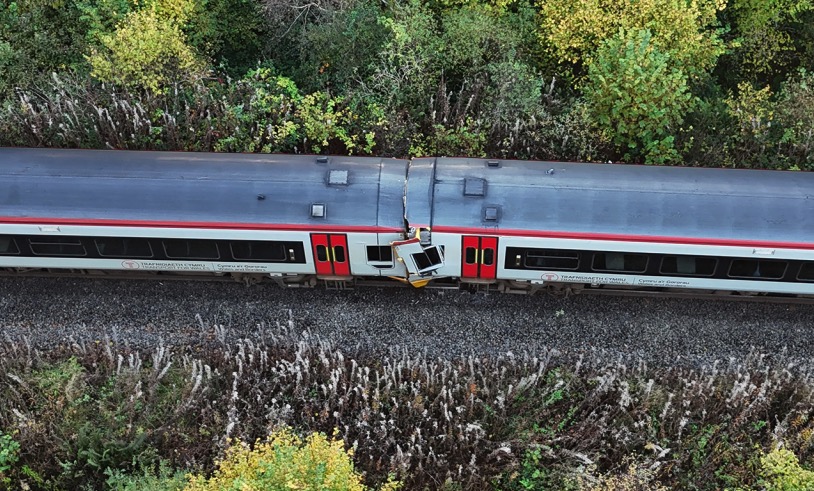
dispensing equipment and excessive approach speed, according to a report published this week by the Rail Accident Investigation Branch.
One passenger died and at least four people were seriously injured when the two trains met head-on near Talerddig in Powys on the evening of 21 October 2024.
The Rail Accident Investigation Branch (RAIB) has now published its findings, making nine recommendations directed at Transport for Wales, Network Rail, and the Rail Safety and Standards Board.
The 18:31 Shrewsbury to Aberystwyth service overshot the passing loop at Talerddig, a section of track where two trains on a single-line route can pass each other, by around 1,080 metres, continuing into the stretch of line already occupied by the incoming 19:09 Machynlleth to Shrewsbury service.
The collision occurred at a combined speed of roughly 30 mph, with the Shrewsbury-bound train travelling at approximately 6 mph and the Aberystwyth-bound train at approximately 24 mph.
RAIB found that three factors combined to cause the overrun.
The rails in the area had low grip levels, though not unusually so for that stretch of line in October.
Both sand-dispensing systems on the train, which spray sand onto the rails to improve grip and allow braking, failed to work.
The automatic system had an electrical fault in its control circuit and did not dispense sand, while the driver did not activate the manual emergency sander.
The third factor was that the train was travelling too fast on the approach to the loop to stop given the grip available on the rails.
Once past the loop, the train was on a steep downhill section where grip was exceptionally poor, and the brakes could not slow it before it reached the oncoming train.
RAIB found there were no engineered safeguards to prevent the train from entering the occupied stretch of line once it had overshot its stopping position.
The report identified a further set of underlying factors behind the accident.
One was a possible misalignment between the safety assumptions built into the Cambrian lines’ signalling system and the actual braking performance of the Class 158 trains operating on the route.
The signalling system, which provides continuous monitoring of train movements, was designed on the assumption that trains would brake predictably regardless of rail conditions.
That assumption increased the system’s reliance on the sand-dispensing equipment working correctly, a reliance RAIB said appeared not to have been recognised by those involved.
A second underlying factor was that Transport for Wales’s method of testing the automatic sander gave false confidence.
The standard check could confirm that sand had discharged from the delivery hoses, but RAIB found that dormant or intermittent electrical faults could still be present, meaning the system might not activate when needed in operation.
RAIB also found it probable that Transport for Wales had an incomplete understanding of how its drivers interacted with the Cambrian signalling system, and identified driver training as a possible further underlying factor.
The report also examined factors that affected how serious the collision was for those on board.
One passenger on the Aberystwyth-bound train suffered fatal injuries after colliding with a saloon table during the impact.
RAIB said the design of those tables was such that it caused the fatal injuries, and has recommended a review of standards for passenger train interior fittings.
Internal sliding doors jammed during the collision, blocking an escape route for some passengers, while fallen ceiling panels and open equipment cupboard doors hampered the emergency response.
The driver of the Machynlleth to Shrewsbury service suffered serious injuries.
The guard on the Aberystwyth-bound train was among those seriously injured.
A further 23 people across both trains received minor injuries.
RAIB Chief Inspector of Rail Accidents Andrew Hall said:
“The accident at Talerddig was a tragedy.
“One person lost their life and others were seriously injured in the first fatal train-to-train collision in more than 25 years.
“Widely varying levels of grip between steel wheels and steel rails is an inherent issue for railways and a lot of effort goes into managing this and its possible consequences.
“The Talerddig investigation found factors associated with several of these areas, and related to the way different parts of the overall railway system interacted.
“RAIB has made nine recommendations to reduce both the likelihood and mitigate the consequences of a similar event.
“I sincerely hope the lessons of this accident deliver lasting safety improvements on the Cambrian line, across the ongoing rollout of ERTMS, and on the wider railway network.”
The nine RAIB recommendations cover improvements to sand-dispensing equipment design and testing, a review of how overrun risks are assessed on the Cambrian lines, improvements to future versions of the signalling software, better understanding of railhead treatment on slippery sections, a review of driver training, and a requirement for all on-train staff to have the skills to assist in an emergency regardless of their role.
The Cambrian line reopened on 28 October 2024, seven days after the collision.
Check live fuel prices near you before you set off.
Spotted something? Got a story? Email news (@) deeside.com

NEW: Add Deeside.com as a preferred source on Google to see more of our trusted coverage when you search.
Latest News